George
Mariners' Museum, Uncurated Search Results
Type: Bugeye
Year: 1897
Builder:
Location: Golden Hill
These records are found in the online catalog of The Mariners’ Museum and Park in Newport News, Virginia. Uncurated search results are presented to give researchers and interested readers an idea of whether the museum’s archives contain information about this vessel and whether it may be worthwhile to visit the museum’s catalog search page for further investigation. Uncurated results may be inaccurate or incomplete.
Search mode: Type+Name and Schooner+Name. Search phrase(s): "Bugeye George"; "Schooner George". Results returned: 4. Results displayed in this table: 4.
Use these buttons to send uncurated search results to your own app or text document for further research. First, check the box for any row, or click "Select All" then uncheck any rows. Then click "Show Selections". You can then copy your selections from the text box and past them into your app.
| Fetch? | Row ID | Media | Date | Vessel | Place | Related Places | Inscription/Marks | Subject | Notes | Archive Number |
|---|---|---|---|---|---|---|---|---|---|---|
| 1 | 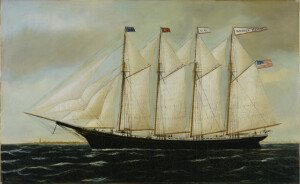 | VESSEL INFORMATION - VESSEL NAME: GEORGE BAILEY VESSEL TYPE: FOUR-MASTED SCHOONER, AMERICAN VESSEL DATES: 1890-1902 SHIP BUILDER: NEW ENGLAND SHIPBUILDING CO. BUILDER LOCATION: BATH, MAINE SHIP OWNER AND MASTER: ASHER CURTIS VESSEL DIMENSIONS: 192.4 x 41.3 x 18.7, 1186 net tons | CL12505 | |||||||
| 2 | 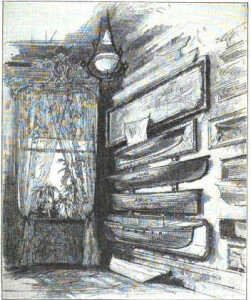 | SHORT DESCRIPTION: Builder’s half hull model, starboard side, made by George Steers of the pilot boat George Steers. The model is a basic representation of the vessel's molded lines, without constructional details. The model is not mounted on a backing board. The model is varnished and is inscribed in black-outlined letters “GEORGE STEERS.” The model has a slightly raked stem and an raked hour-glass shaped upper stern (no counter). It has moderate deadrise and little or no tumblehome. The model shows a boat with deep draft aft and a keel that slopes up to the forefoot. It has a long sharp entry and a long run aft. The model is constructed of 11 pine lifts. The bottom lift (1) is 1-5/8” and tapers to zero about 7-1/2” from the bow. Lifts 3 through 8 are flat and arranged in pairs, each consisting of 1/2” lift separated by a 1/8” lift. The sheer curve is cut into the 9th lift. It is 9/16” amidships, 2-1/16” at the stern, and 1-5/8” at the stem. Lift 10 is flat (1/8”) and curves with the sheer. Lift 11 curves with the sheer and tapers from 1-1/16” at the bow to 11/16” amidships to 3/16” at the stern. Lift 11 is also the top covering for the model, which is not hollowed out to deck level. The top and back of the model have twenty station lines running from bow to stern. Line eleven from the bow is a double line and may be the deadflat. They are spaced an 1-3/4” apart. There appear to be some scratched letters between several of the station lines but it’s unclear what they represent. The dimensions of the model are 34-1/4” (length overall); 4-11/16” (main breadth), 4-1/2” (half breadth), leaving a tumblehome of just 3/16”. Height overall is 6” (at the stern). The minimum half-breadth of the model is 3/32" along the edge of the stem and 1/8” at the stern. The lifts appear to be held together by six pegs running from top to bottom. The pegs are visible on the front surface of the model. There are a few variously sized holes whose purpose is not apparent on the top and back and front of the model. The model is in good condition. The varnish is stable. There is damage and some wood loss at the ends of lifts 2 through 5 at the bow. There is a separation between lifts 4 and 5 at the bow and stern. There is a small scratch through the ‘GE’ in the ship’s name. There is some wood loss in the second G. It appears as though another layer of varnish was applied to the model at some point in the recent past. NOTES: The collection of half models MR 5 through MR 24 are of vessels built by shipbuilders Henry (father), James Rich and George (sons), and Henry Steers (son of James Rich), builders of the famous yacht America. The models document vessels built between 1805 and approximately 1876. They encompass all types of vessels from a catboat up to large steam sloop built for the US Navy. In a February 13, 1963 letter Howard I. Chapelle, Curator of the Division of Transportation at the Smithsonian stated “The Steers Collection is important technically and it is something we envy the Mariners’ Museum’s possession.” NOTES: Text from “The Evolution of the American Yacht” in The Century Illustrated Monthly Magazine, Volume 24, page 352: Another modification of the Baltimore clipper was developed in our pilot-boats, which, little by little, assumed the type represented by the George Steers and Mary Taylor, famous little schooners designed by George Steers in 1845,--a type which continues to be followed, with little variation, in this service event now, after a lapse of forty years. They have a keel sloping up to the fore-foot, deep draft, great dead rise on a vertically sharp floor, and a sheer both at stem and stern which makes them buoyant and dry in a sea-way. Text from Pilots, The World of Pilotage Under Sail and Oar, Volume 1, page 82: [In 1851] Steers now came along with the 77ft George Steers, a shameless America derivative, but with a fashionable shorter bow overhang and an even more effective run. Steers was a favorite of Howard I. Chapelle and as one enjoys the pure perfection of her lines, one can see why....The George Steers stands as a fine example of that designer's final ideas of what a pilot schooner should be. Chapelle considered her run a slight improvement over that of America, while one can only agree that the balance of her ends is remarkable. This feature, coupled with a sensible depth of body would have conferred great seaworthiness and ease of motion, while the firm bilge of her midship section would ensure the now-usual Steer's feature of great power. Despite the altered profile, it is impossible to miss the similarity to America in the lines of this considerably smaller boat. She is said to have been one of the finest pilot craft ever built. The George Steers was driven ashore near Barnet Inlet in a notorious northeaster on February 12, 1865. All hands perished. VESSEL INFORMATION— VESSEL NAME: GEORGE STEERS VESSEL TYPE: Pilot boat, Pilot schooner DESIGNER: George Steers SHIPBUILDER: William H. Brown Shipyard BUILDER LOCATION: Foot of Twelfth Street, New York, New York SERVICE DATES: 1852-1865 DATE WRECKED: February 12, 1865 VESSEL DIMENSIONS: 60 tons; 77'4" (length overall), 71' (waterline length) x 18'10" x 9'6" VESSEL HISTORY: New Jersey Pilot Boat George Steers No. 6 • The Buffalo Commercial, Monday August 9, 1852: Launch.—A beautiful pilot-boat modeled by Geo. Steers, the builder of the yacht America, was launched by moonlight, at 12 o’clock on Thursday night, from the yard of Wm. H. Brown in New York. She was built for the Jersey pilots; has the same lines as the “America,” and is about half as large, or 87 tons. She will be the most beautiful as well as the fleetest pilot boat out of port. • The New York Times, August 20, 1852: The new pilot boat, built by Mr. George Steers for a company of Jersey Pilots, and named in honor of the builder, was got under way this morning for the first time, at the foot of Twelfth-street, East River. She left under command of Mr. Steers, who, in company with a few friends and acquaintances, will go as far as White Stone, to test the sailing qualities of the vessel, and for a pleasure excursion. • New York Herald, March 4, 1854 reported: the schooner George Steer had arrived (Honduras) with the president of the proposed railroad from Cabello to Tigre Island, who had gone on to the capital to consult with Mr. Borland. The George Steer, on her return, would take on board a Central American Minister to this country. • New York Daily Herald, March 10, 1854 reports: Interesting from Honduras (Jan. 22, 1854) Arrival of schooner George Steers—The most notable incident is the arrival of the schooner George Steers, from New York, in the unprecedented short time of a little more than thirteen days. She brings out Amory Edwards, Esq., President of the Honduras Railway Company, who left this morning for Comayagua, the capital, where he is gone with the local agent of the company to arrange for the commencement of practical operations on the line….The George Steers remains in port for the purpose of conveying to New Orleans the newly appointed Envoy to this State to the American government. • New York Daily Herald, April 8, 1854 reports: Omoa, Honduras, March 16, 1854: The George Steers is still here, in the employ of the Honduras Railway Company. • New York Daily Herald, May 24, 1854 reports: By the arrival yesterday in the lower bay, of the pilot boat George Steers, from Honduras via Omoa…The George Steers brings us as passengers General Joe Barrundia, Minister from Honduras, to represent the New Central American Mission at Washington, Don Laiuo Lasso, Secretary of Legation, the wife and son of the former, A. Edwards of New York [president of the Honduras Railroad Company], Herman Schmidt, of Brunswick, Germany, Mr. Charles Foller and Miss Foller of Omoa. The George Steers proceeds direct to New York. • New York Tribune, March 6, 1855 reports: Look out for slave catchers: A small incident occurred at the Black-slip, foot of Beekman St., in this City early this afternoon, which may serve as a caution to this community, which has been comparatively quiet on the subject of slave-catching since 26th of last May, when the case of Stephen Pembroke was so summarily disposed of. The George Steer, pilot-boat, laying is said slip, has two colored men employed in her service. As one of these men, who had been on shore, was about to step on board, he was hailed by two unstarred men, assuming to be officers in search of a burglar, intimating that he was the man, and demanding that he should go with them, at the same time touching him on the shoulder. He very wisely asked them to show their warrant. This was not done, but they insisted upon his going with them. At this time persons who had been watching the movement, stepped up and sustained the position taken by the man, that they were bound to show their warrant. While matters stood thus, two starred officers interfered, and said “he had better go with them to the Chief’s office; they are officers.” The result was that the man was attended by two faithful friends, who had some trouble before they were admitted. I have two prime witnesses to these transactions. This matter calls for explanation. Officers, starred or unstarred, have no right to arrest a man on charge of a serious crime without a warrant, or without knowing his name. This arrest was made in open day, when he was going about his honest business. (the article continues), written by J.W.C. Pennington. • Buffalo Daily Republic, October 2, 1858 reported: The steamer Delaware, hence for Philadelphia, came in contact, off the Woodlands, last evening, with the pilot boat George Steers. The latter lost bowsprit and had her bows stove in three or four feet, which caused her to leak badly. The Delaware towed her to quarantine and proceeded on her voyage. • New York Daily Herald, March 26, 1860 reported: the pilot boat George Steers towed the hulk of the sloop Spray (30 tons) from Barnegat Bay to port. It was assumed that the murder of Captain Leete and his brother had occurred and it was being investigated. • New York Daily Herald, May 10, 1860 reported: The arrival of the Japanese Embassy aboard the steam frigate Roanoke, arrived and anchored inside of Sandy Hook on May 9th.The ship was told to proceed to Hampton Roads and not enter the port (of New York). The NYDH’s special correspondent on board procured the services of the George Steers, and came up to town last evening with his despatches. • New York Times, February 23, 1865: Probable loss of the Pilot-boat George Steers and Crew. The pilot-boat George Steers has been missing since the gale of the 12th inst., and information has lately been received in this city which renders her total loss almost a matter of certainty. The last pilot was put out from her on the 11th inst., off Cape May. During the gale of the 12st inst., a pilot-boat was seen on the South Shoals near Barnegat. At daylight, the next morning, she appeared to be almost a wreck, all her masts having gone. On the 14th inst., a surf boat was enabled to get to her, but there was nothing of her left but a piece of the deck, some spars and rigging. A piece of her burgee was found in the rigging, with part of her name, which was “eorge.” All hands on board must have perished. Some dead bodies were found about twelve or fourteen miles south of where she lay, and as there was a heavy current setting in that direction at the time it is supposed they were the bodies of some of her crew. The George Steers was built in 1851 by the eminent ship-builder of that name. She belonged to the New Jersey Association; was valued at $15,000, and was supposed to be the fastest boat sailing from this port. ADDITIONAL INFORMATION: Chapelle, H.I. American Sailing Craft. 1936. pages 213-215 (VM331 C4); Russel, C.E. From Sandy Hook to 62 degrees". New York. 1929. page 387.; | CL14541 | |||||||
| 3 | 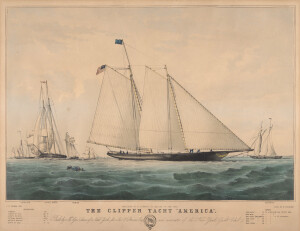  | SHORT DESCRIPTION: Colored lithograph showing a starboard view of schooner yacht America on port tack off the Isle of Wight. The other yachts pictured are the Capricorn, schooner Gipsey Queen, topsail schooner Xarifa and Surprise. The image does not show the August 22, 1851 race as three of the named yachts did not participate in the race: Capricorn, Xarifa (which was positioned off Cowes to mark the location of the start and finish line), and Surprise (whose sailors had joined the crew on the yacht America). NOTES: [Text from metmuseum.org] A syndicate of New York Yacht Club members, headed by its charter member Commodore John Cox Stevens, decided to build a yacht to sail to England. Their purpose was twofold: to show off U.S. shipbuilding skill and to make money by competing in yachting regattas. On August 22, 1851, their clipper yacht "America" was the first American ship to beat the international competition in the Royal Yacht Squadron's 53-mile (85 km) regatta around the Isle of Wight. Figuring that a picture of this ship would be popular with New York's yacht club members and other American fans, Nathaniel Currier maximized the opportunity to publicize this victorious occasion by making several lithographs of this suddenly famous clipper yacht, which was subsequently sold ten days after the memorable race. The Squadron's "One Hundred Sovereign Cup" or "£100 Cup" was later renamed the "America's Cup" in honor of the original winning yacht featured in this lithograph. NOTES: Frances Flora (Fanny) Palmer was one of the most important artists working for Nathaniel Currier, and later Currier and Ives, between 1849 and 1868, when she produced approximately 200 of the firm's best landscapes and most engaging scenes of daily life. VESSEL INFORMATION - VESSEL NAME: AMERICA VESSEL BUILT: 1851 VESSEL TYPE: CLIPPER YACHT, AMERICAN SHIPBUILDER: GEORGE STEERS BUILDER LOCATION: NEW YORK, NEW YORK, | CL19724 | |||||||
| 4 | 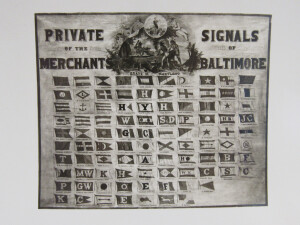 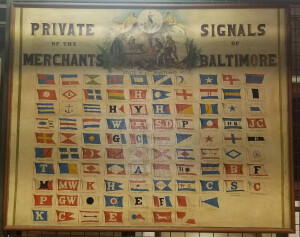 | SHORT DESCRIPTION: Oil on canvas by unidentified artist of private signals of Baltimore merchants, mid 19th century, ten rows and ten columns of flags (total 95) on yellowed white background, green lined border. Center of vignette shows various indian maidens or allegorical figures plus one of indians burning a log to make a dugout canoe. NOTES: A. Brown & Sons is Alexander Brown, who had nearly 13 partners in his banking firm. F.W. Brune & Sons is Frederick W. Brune (1776-1860) who started the company with his sons, John Christian Brune and William H. Brune. Frederick had worked with Von Kampf who died in 1828 so Brune started his own company. J. Corner & Sons stands for James Corner, they owned wharf property in at least 1860. Hugh Jenkins & Co. existed in 1859 when Col. J. Stricker Jenkins (Hugh's son) joined the firm at age 28. The firm became one of the largest coffee importers in the country. Col. Jenkins died 1878 leaving his brother, Benjamin W. Jenkins, as the sole partner remaining. Jas. A. Hooper is James A. Hooper, a merchant who started a shipcandlery and grocery company with his father, William, and Benjamin Hardester in 1836. His obituary in The Baltimore Sun, May 20, 1897, said he also traded in coffee from Rio and indentured servants from China, then later entered the banking world as Hooper, Reese, & Co., he was 82 when he died. T.J. Hand & Co. - From 1851-1861 William Hand Browne worked with his cousin, T.J. Hand as commission merchants. They were export merchants and traded mostly with Peru on a clipper called Seaman’s Bride (From the Johns Hopkins University Circular, "In Memoriam William Hand Browne, 1913) Henry M. Warfield lived from 1826-1885, he was a merchant, senior director of the B&O Railroad, and founded of the Baltimore & Havana Steamship Company in 1866. The Daily Exchange newspaper reported in 1860 that the company Davies & Warfield was dissolving because Davies had died, and that Henry M. Warfield was partnering with A.R.H. Ranson to create Henry M. Warfield & Co. for the purpose of conducting general and milling business. Henry M. Warfield & Co. is listed as the agents for the BHSC in 1866. Kirkland Chase & Co. was owned or started by Thorndike Chase, dealt in West Indian trade in sugar and coffee but went bankrupt in 1873 Spence & Reid - From the portrait collection of Johns Hopkins Medical Institutions: William Wallace Spence was born in 1815 and came to America at age 18 from Scotland. When he moved to Baltimore (after first living in New York) he met Andrew Reid and began the firm known for building clipper ships. He started or was involved in several other ventures, Spence died in 1915. The company appears in newspapers as early as 1848. From The Baltimore Sun, July 4, 1874, the partnership of Spence & Reid became Spence, Montague, & Co. working in general commission business, signed William W. Spence, James C. Spence, Dibbell P. Montague, and William W. Spence, Jr. Fritzgerald Booth & Co. should be spelled Fitzgerald; Washington Booth and Captain Richard G. Fitzgerald formed a partnership about 1846. Fitzgerald stayed in Baltimore and Booth went to Lima, Peru. (From History of Baltimore City and County From the Earliest Period to the... 1881, page 771) B.M. Hodges, Junior - B.M. Hodges, Jr & Co. was an importer and shipping merchant at 49 Exchange Place in 1874. Ship Casilda built for them in 1856, was 950 tons. Foard & Rogers was Joseph O. Foard and C. Howard Rogers, the firm dissolved in 1868 when Rogers left and Foard continued working under the name Joseph O. Foard & Co. (From The Baltimore Sun, 4 April 1868), he died in 1908 (see obituary). Friend & Ricketts & Co. – Should be Friend, Ricketts & Co.; (From The Baltimore Sun, February 4, 1863) Dissolution of Co-Partnership with Alfred Friend, Wesley Ricketts, and Thomas Henry Fitzgerald because Fitzgerald left the company. The name didn’t change. W. Rhoads & Son - John R. Rhoads was a shipbroker for the company in 1873 at Pratt St. and Smith’s Wharf W.H.D.C. Wright & Co. William Henry DeCourcy Wright James Cheston & Son – James Cheston (1779-1843) and son Galloway (born 1806-1881), Galloway worked with his father in the company for 55 years as a manufacturer and shipper of flour. He also owned many ships that allowed him to trade frequently with Brazil for coffee. Galloway Cheston died March 9, 1881 according to his obit in The Baltimore Sun on March 10, 1881, page 4. The company is listed in the 1841 Maryland Colonization Journal as a subscriber. James Hooper & Sons – Stockholders in Farmers’ and Planters’ Bank for 1840. Annual Report of the Baltimore Chamber of Commerce for the Year 1880, Volume 25 has Henry Hooper of the company at 8 Spear’s Wharf, as well as Thomas L. Ramsey. A. Schumacher & Co. began in 1823 shipping tobacco, cotton, and passengers between Baltimore and Germany. Albert Schumacher partnered with North German Lloyd in 1868 to become their general agents in the city. NGL advertisements have their address as 5 South Gay Street in 1891, and by 1914 they worked from 306 Charles Street in what was known as the Hansa House. The firm also worked as agents for the Allan Steam-Ship Company in 1889. See The Baltimore Sun, 16 December 1911. F.L. Brauns & Co. – German shipping house, existed as early as 1849 when Werner Dresel joined the firm as a partner, they were a Tobacco and General Commission House. The firm became W. Dresel & Co. in 1872 with brother Ferdinand Dresel, became Dresel, Rauschenberg, & Co. in 1876 when Herman Rauschenberg joined. (From The Monumental City: It’s Past History and Present Resources by George Washington Howard, page 863.) Schaer & Kohler appears in newspapers as early as 1854, worked as shipping and commission house from 69 Exchange Place by 1860. D.H. Watjen & Co. was a German company founded in 1821 by Diedrich Heinrich Watjen, became D.H. Watjen & Co. in 1829, his son Christian Heinrich Watjen took over in 1858. By 1914 they had three ships which were all impounded with WWI and they did not restart the company after the war. Schwartz & Dix were importers and dealers in fruit at 112 W. Lombard Street in 1860 though they appear in newspapers at 117 Lombard St. between 1858-1859. Kelsey & Gray were shipbrokers and commercial merchants in as early as 1851 and as late as 1868 on Pratt Street. The Maine Historical Society has a letter from a father to his wife that the company took up subscriptions to provide barrels of food to imprisoned soldiers during the Civil War, including their son. The owners were Henry Kelsey (hence the HK on the flag) and Andrew Gray, who both lived in 58 E. Baltimore in 1858-1859 according to the city directory. They co-owned the schooner George Latimer which left Baltimore in 1864 but was captured and destroyed by the Florida. Brothers Boninger, possibly spelled Bonninger, was a German shipping firm started as early as 1849 to ship tobacco. Lambert Giddings owned the ship Sir John Franklin which ran ashore in January 1868 and lost 12 sailors including the captain, though eight survived. John Currier Jr. was a shipbuilder who worked in Newburyport, MA. Between 1831 and 1843 he built six ships for the Black Ball Line and several others but launched almost 100 ships between 1831 and 1884. Currier retired in 1884 and died in 1887. (From City of Newburyport preservation statement for the house he used to own at 342 Merrimack Street). His connection to Richmond is unclear. Whedbee & Dickinson were James S. Whedbee and John S. Dickinson. They appear in newspapers in the mid-1850s and were commission merchants in cotton and southern lumber. The New Bern, NC paper, The Daily Journal reported on 7 June 1892 that their property at Old Dominion Wharf was being sold at auction. Sterling & Ahrens were shipping merchants who wound up with too much molasses in 1875 and went bankrupt. (From The Star Tribune [Minneapolis] 28 August 1875. James Carey Coale's April 14, 1891 obituary from The Baltimore Sun on page 6 says Mr. Coale died the night before, had “been engaged in the insurance business as agent for the Lloyds and foreign and American underwriters and adjuster of marine averages and as steamship passenger agent in this city since 1852. The firm name was James Carey Coale & Cunningham, with office at 27 South Street.” Born May 25, 1825 “engaged in the shipping business on his own account in 1847, but gave it up in 1852 for marine insurance. In 1858 he was appointed agent for Lloyds.” Thomas Pierce was a coffee importer who owned the brig Red Wing (built in 1857) which was lost at sea in November 1873 (From the Baltimore Sun). W.H. Perot is William H. Perot whose 9 June 1903 obituary in The Baltimore Sun reports that he was the head of the shipping company W.H. Perot, Son, & Co. at 33 South Gay Street. He was born to an English family in Bermuda in 1826, started A.W. Perot & Co. with his brother and he moved in Baltimore in 1855 to continue working. He owned several clipper ships. Oelrich & Lurman should be Oelrichs; Henry Ferdinand Oelrichs was a senior partner in the firm, E.G. Oelrichs and Gustav W. Lurman (distant cousins) started E.G. Oelrichs & Lurman in 1830, then Henry Oelrichs joined as a junior partner in 1838. When E.G. left in 1842 Henry and Gustav formed a new company, Oelrichs & Lurman. Henry left in 1861, and the firm became Lurman & Co. (From “German Merchants in the Nineteenth Century Atlantic” by Lars Maischak, pages 44-46) Rose & Lyon was at the corner of O’Donnell’s wharf and Pratt St as agents for New York Packets in 1860. Ira C. Lyon’s obituary in The Baltimore Sun, 24 November 1898, page 10 says that he was born in Connecticut and moved to Baltimore at age 16. He started the firm with John Rose in 1850 which lasted until Rose died 15 years ago (about 1883). Wm. Applegarth & Son – (From Baltimore Brick By Brick) William Applegarth captained ships then owned them, then was a master broker. He died in 1873 but his sons, Nathaniel & Thomas, continued the business. J. Hooper & Co. were shipbrokers at Gay and Lombard Streets Floating School was just that, a school on a ship to train sailors in the merchant trade. Captain Robert Leslie began the school on September 14, 1857, though the approval process began in 1850. The school was necessary because there was a lack of sailors who could manage the expanded trade to California and the Pacific. The committee received approval from the Navy to purchase the ship Ontario to be used for the purpose. The Ontario had been a sloop of war built in 1813 but had become a receiving ship before the school purchased it. Many of the companies and people represented on this flag provided funding to purchase the Ontario. From A Brief History of the Establishment of the Floating School of the City of Baltimore, published by Bull & Tuttle, 1860. M.A. Mitchell (From The Daily Exchange, June 8, 1860) Notice of Dissolution of Co-Partnership between John H. Travers and Marcellus A. Mitchell of firm Travers & Mitchell because Travers died. Notice is dated December 29, 1859. “Marcellus A. Mitchell will continue the ship chandlery, ship brokerage and commission business at the old stand, No. 2 Spears Wharf, for and on his own account, risk, and benefit.” Steamer "Mary Washington" was operated by the Weems Line, which started in 1819 and was incorporated in 1827. Weems Line was one of the first and eventually one of the oldest passenger-freight steamboat lines operating between Baltimore and Patuxent and the Rappahannock River points. Weems Line survived individually for 88 years then merged with other lines that lasted through the 1920s. (From Calvert Marine Museum's Bugeye Times, Vol. 41, No. 4, Winter 2016-17.) Mary Washington was purchased in 1854, abandoned in 1888. (From Calvert Marine Museum's Bugeye Times, Vol. 7, No. 4, Winter 1983.) The Baltimore & Susquehanna Steam Company operated two steamers, but side-wheel steamers Mary Washington and Wenonah were connected to the line operating on different days. "They measure 200 feet in length, 28 feet beam, and 9 1/2 feet hold, with respective capacity of 700 tons." (From The Stranger in Baltimore: A New Handbook... 1866, page 153) J.W. Hugg & Son owned the bark Maggie V. Hugg Steamer William Selden was chartered by the Baltimore Steam Packet Company, they then purchased it in 1859. April 1861 in Portsmouth the Confederates interned her and was used her in the Norfolk harbor until October 10, 1862 when Confederates burned her as they evacuated Norfolk and Portsmouth. (From William and Mary Quarterly, October 1938, Vol. 18, No. 4) Steamer "Cecil" was a Union transport steamer, used in 1863 to take slaves away from their owners. A journal from the steamer was up for auction and not sold but made note that the Cecil was privately owned but hired by Union to transport military recruits and ordnance, contract signed August 1863. Steamer "Planter" was a side-wheel steamer built by the Weems' Steamboat Line in 1845 (similar narrative to the Mary Washington). George Weems' three sons captained the boats he built, Captain Theodore Weems on "Planter." "Planter" ran into Fort Carroll in the Patapsco River in 1855 and sank but was raised and used by the Government in the Civil War. She was abandoned in 1881. (From Calvert Marine Museum's Bugeye Times, Vol. 7, No. 4, Winter 1983.) Steamer "Geo. Weems" was part of the Weems' Patuxent River Line. "The side-wheel steamers 'Matilda' and 'George Weems' compose Weems' Passenger and Transportation Line, running Wednesdays and Fridays, for Fairhaven, Plum Point and the Patuxent River. They are about 200 feet long, 28 feet beam, and 9 feet hold, with an average capacity of 650 tons." (From The Stranger in Baltimore: A New Handbook... 1866, page 154). The "George Weems" was built in 1858 replaced the "Patuxent" steamer, but burned June 10, 1871 and was replaced by the "Theodore Weems" steamer in 1872. (From Calvert Marine Museum's Bugeye Times, Vol. 7, No. 4, Winter 1983.) "Lioness & Tigress" were steam tugs of the Monumental Line J.F. Farland was a schooner, wrecked at Cape Hatteras Nov. 30 1872 with 216 bales of cotton and 350 tons of phosphate for Boston, the crew survived. (From Commercial and Financial Chronicle and Hunt’s Merchants’ Magazine 1872) W.T. Kendall was William T. Kendall who imported guano as early as the 1850s. Steamer "Hugh Jenkins" was built in 1849 for Eastern Shore Steamboat Company, part of USQMD from 1861-1866, sold March 1, 1866 to Kent Island Steamboat Co. and changed names to Kent Island. | CL12615 |
Created 2026 by Don Barker, CBMM volunteer, for the Chesapeake Shipbuilding Project. shipbuilding@sailingworkboats.es